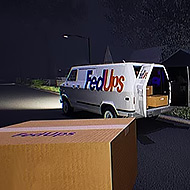
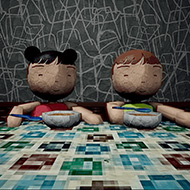
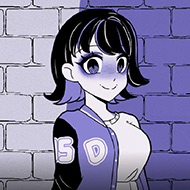
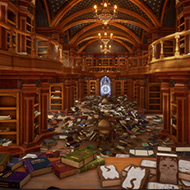
Bloodshot eyes in No, I’m not a Human do not work the way most new players assume they will. The nightly broadcast tells you red eyes are a warning sign of a Visitor, so the instinct is to treat every guest with a tired, reddened stare as a threat and reach for the shotgun. Except crying causes red eyes too, and a can of EnerJeka or a cup of coffee will do the exact same thing to a completely human guest who just wants to make it through the night. That gap between what the broadcast tells you and what a trait actually proves is the whole point of the nightly ritual: letting strangers into a house during a slow solar catastrophe, checking them for symptoms that are only ever probably true, and deciding who gets to stay.
Symptoms That Lie in No, I’m not a Human
Every day, a new physical trait gets added to the list of things that supposedly separate a Visitor from a human being. Flawless white teeth, dirt under the fingernails, bloodshot eyes — these sound like solid evidence until you actually start using them. Some Visitors turn out to have completely normal eyes or ordinary, unremarkable hands. Some humans have hairy armpits, stained teeth from smoking, or scraped knuckles from a fight that has nothing to do with what they are. The traits are clues, not proof, and the game never pretends otherwise once you’ve been burned by one.
Spending the day phase productively means burning through a finite pool of energy, either by examining specific body parts on your guests or by drinking beer to pass the hours instead. Players who try to examine everyone thoroughly every single day run out of energy fast and end up skipping checks on guests who needed them most. The ones who read backstories and cross-reference what a guest says about themselves against what the broadcast claims tend to catch more inconsistencies than the ones purely chasing physical symptoms.
Veteran players tend to settle into a rough order for checking traits, since some symptoms are temporary and others are more stable across a visit.
- Teeth first, since discoloration from something mundane like cigarettes is easy to rule out through conversation.
- Fingernails next, checking for dirt that a guest can plausibly explain away with a story about travel or labor.
- Eyes third, because redness fades and reappears depending on what a guest has had to eat or drink that day.
- Hands or armpits last, since the Vigilante later demands exactly this kind of proof and it’s worth knowing a guest’s baseline early.
None of this turns the guesswork into certainty. That’s arguably the intended discomfort of No, I’m not a Human — you are never fully sure, and the game is built around living with that.
The Night the Intruder Comes Knocking
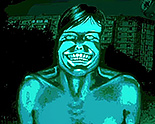
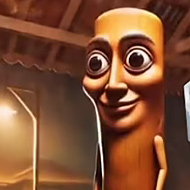
The Intruder — also called the Pale Man, the Pale Visitor, or the Pale Maniac in the in-world news reports — is the closest thing the game has to a mascot villain. Pale skin, broad shoulders, unnervingly long and skinny arms, an eerie grin that shows off perfectly white teeth, and nothing worn but a pair of dark pants. He first shows up on the third night, and by the fourth he’s standing at the door asking the protagonist a direct question: are you alone?
Answer honestly that you are, and he kidnaps and kills you on the spot. If there are other guests in the house at the time, he backs off instead, warning that he’ll return the next time the house is empty of everyone but the protagonist. That warning isn’t idle. He resurfaces on later marked nights, and the single rule that keeps players alive through those nights is simple: never let the house go completely empty when he’s due to show up again.
Players who came into the game expecting a straightforward jump-scare monster tend to be surprised that the Intruder is more of a standing threat you manage through housing decisions than a set-piece you fight or outrun. That reframes the whole admit-or-reject decision at the door — sometimes you’re letting someone in not because you trust them, but because an empty house is its own kind of danger.
The Cat Lady’s Price of Admission
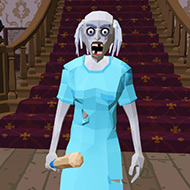
Among the recurring guests, the Cat Lady stands out because almost nobody argues she looks human. Community advice is nearly unanimous anyway: let her in. Doing so grants access to the Cat, a mechanic that unlocks Cat Food usage and opens up otherwise unreachable endings. She occasionally kills a guest on the very first night you let her in, and players still call the trade worth it for what it unlocks later.
Her defining trait isn’t a symptom on the daily checklist at all — it’s what she does when threatened. Her ability to contort and bend her body to absurd degrees, even enough to dodge a shotgun blast, is treated in the community as a far more reliable giveaway than anything from the trait list. She generally spares the protagonist directly, but she’ll still kill other human guests in the house if another Visitor happens to be present at the same time, which makes her presence a genuine gamble depending on who else you’ve let stay.
Completionists chasing every branch of the ending tree tend to treat the Cat Lady as a mandatory early admission rather than an optional risk, since several endings are gated behind the Cat mechanic she brings with her.
FEMA Notices and the Vigilante’s Proof
The Vigilante shows up on nights eight, ten, and twelve with one demand: prove you’re human, or die. The safe way to satisfy him is showing your hands or freshly cleaned armpits, since those traits are harder to fake temporarily than teeth or eyes. That matters because both teeth and eyes can shift for entirely mundane reasons — cigarettes discolor teeth, EnerJeka and coffee redden eyes — and those changes are temporary, which means a guest who looked suspicious on Monday might look completely clean by Thursday.
FEMA works differently from every other threat in the house. FEMA Notices, obtained from FEMA officials or occasionally offered as a bribe by a guest trying to save themselves, guarantee that a specific character gets removed the next time FEMA does a sweep. FEMA also acts on its own schedule regardless of notices: it removes one resident during nights four and five, then two residents each on nights eight and ten. Players who understand this timing use FEMA Notices as a way to eliminate a suspicious guest without burning energy on an examination that might not even settle the question.
That’s the appeal for the efficiency-minded crowd — instead of spending a full day’s energy interrogating someone with ambiguous symptoms, you can quietly mark them for removal and let the system do the work. It’s a colder way to play, but the game doesn’t punish it any harder than the alternative.
Energy, Kombucha, and the ForRest Delivery Service
The energy system underpins nearly every decision during the day phase. All of it has to be spent, whether on body-part examinations or on drinking beer to skip time, before the day can end. Saving progress runs through Kombucha jars, which get consumed each time you save — except for the “save and quit to desktop” option, which preserves a save without burning a jar, a trick regular players rely on heavily for runs aimed at specific endings.
The ForRest Delivery Service opens up as the days go on, and the moment it’s available, most guides push players to start ordering immediately. EnerJeka cans, which restore stamina, and Cat Food are the two priorities, since orders are limited to one item type at a time with a multi-day cooldown between them. Clicking the bedroom TV an extra time or two per day and listening to the hallway radio once daily both surface additional items and phone numbers that aren’t obvious on a first playthrough.
Not everything about the house holds up under scrutiny, though. A common complaint in player discussions is that the basement and several household items feel underused — systems that are introduced but never really pay off the way the trait mechanics or the delivery service do. It’s a fair criticism, and one the game doesn’t really answer.
The Randomization Fight Inside No, I’m not a Human
A demo update in June 2025 added randomized identities to most guests, and it split the community more than anything else about the game. The complaint is straightforward: if a guest’s fate is randomized regardless of what you decide, there’s no real reason to reject anyone at the door in the first place, since your choice isn’t meaningfully connected to the outcome. Some players say this turns the trait-checking and dialogue into background noise rather than the tense decision-making the game is supposed to be built around.
Other players push back hard on that read. For them, randomization is exactly what makes repeat playthroughs worth doing, since a guest who was safe last time might not be safe this time, and that unpredictability keeps you from coasting on memorized patterns once you know the guaranteed-human and guaranteed-Visitor characters by heart.
The reception around all of this landed generally positive despite the argument — a score in the high 70s on Metacritic, a similar recommend rate on OpenCritic, and more than a million copies sold within months of release, with comparisons to Papers, Please and This War of Mine showing up constantly in reviews. The randomization debate hasn’t dented that reception so much as become the thing every returning player has an opinion about.
Questions Players Ask About No, I’m not a Human
Do the physical traits actually prove someone is a Visitor in No, I’m not a Human?
No. Every listed trait — teeth, fingernails, eyes, and the others introduced over time — has a plausible human explanation, and some confirmed Visitors show none of the traits at all. Treat the trait list as leverage for a conversation rather than hard evidence, and weigh it against what a guest says about their own life and injuries before deciding anything at the door.
What happens if you’re alone when the Intruder knocks?
If the protagonist is genuinely alone in the house when the Intruder appears and admits to it, he kidnaps and kills them immediately. Having any other guest present at the time defers him instead, and he leaves with a warning that he’ll come back once the house is empty again, which is why experienced players avoid letting every guest leave or die at once near his marked nights.
Why did the randomization update change how people play No, I’m not a Human?
The update, added during a June 2025 demo build, randomized most guest identities outside a handful of preset guaranteed-human and guaranteed-Visitor characters. It means memorizing a fixed cast no longer guarantees safe decisions, which some players find frustrating because it weakens the sense that choices matter, while others find it makes every night genuinely tense again on repeat playthroughs.
No, I’m not a Human ultimately isn’t about getting through every night clean — it’s about living with the guesses you got wrong, whether that’s a Grieving Mother you turned away out of paranoia or a Kombucha jar you burned on a save that didn’t need saving. The Intruder will always come back for the nights you spend alone, and no amount of memorized trait charts changes that.