You’re crouched behind a hedge in a quiet Happyhills backyard, clown mask fogging up with every breath, watching a man mow his lawn like nothing bad has ever happened on this street. He hasn’t seen you yet. The mower drowns out your footsteps as you close the gap, sledgehammer already in hand, and for a second the whole game narrows down to one question: does he turn around before you swing? That opening tension is the entire pitch of The Happyhills Homicide in a nutshell, and it repeats, level after level, for the rest of the run.
Who the Pale Grin Really Is
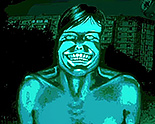
The killer you control is known in-game as the Pale Grin, a clown-masked figure working through a hit list in the town of Happyhills. Underneath the mask is John Wade, a former janitor at Westpine High who spent years getting bullied and humiliated by staff and students alike, including a teacher named Gordon Baker. The game frames his rampage as revenge fantasy rather than random slasher chaos, and every target on the list connects back to something that happened to him at Westpine.
The one person who treated him with any kindness was a student named Madison Carpenter, John’s sister, whose photo he kept and whose memory shapes a lot of the story’s quieter, sadder beats. Their history isn’t played as a twist you’re supposed to guess; it’s laid out gradually through cutscenes and environmental details, which is part of why players who went in expecting a straightforward gore reel end up talking about the story almost as much as the kills.
What makes the setup work is that the game doesn’t ask you to like John Wade so much as understand why Happyhills fears him. Detective work later in the campaign fills in the parts of his past that the killing sprees only hint at, so the Pale Grin identity feels earned rather than slapped on for marketing.
Moving Through the Tapes in The Happyhills Homicide
Levels are structured as Tapes, twenty of them in total, plus four additional Happyhills Vice levels and one flashback level that breaks from the main structure. Names like Edge of Your Seat, Nine Inch Nails, Don’t Drop the Soap, Number One Fan, Kill ’em Mall, and Meet Your Maker give a sense of how much the game leans into dark humor even while it’s setting up a murder. Each Tape drops you into a self-contained location, from a lawn mower scene to a biker bar to a crowded shopping mall, with its own layout, witnesses, and kill opportunities.
The rhythm inside a single Tape stays fairly consistent once you’ve played a few:
- Watch the target’s patrol or routine long enough to learn when they’re isolated.
- Move in without crossing another character’s line of sight.
- Strike when the opening actually appears, rather than forcing it.
- Deal with the body or evidence before anyone notices something is wrong.
That loop is simple to describe but harder to execute cleanly, especially once a Tape adds a second witness or a patrolling car. Players who try to brute-force a level by rushing usually get spotted, which resets the tension they were building. The ones who slow down and actually read a target’s pattern tend to have a much smoother time.
Detective Bryan Pawalski and the Other Half of Happyhills
Roughly half the campaign puts you on the opposite side of the investigation as Detective Bryan Pawalski, the Happyhills PD investigator assigned to figure out who’s been leaving bodies around town. These segments swap the stealth-kill loop for scene examination, clue gathering, and piecing together what the Pale Grin left behind, and they give the game its puzzle-solving identity rather than making it pure slasher power fantasy.
It’s a deliberate structural choice: instead of one long murder spree, the campaign keeps cutting back to the people trying to stop it, which raises the stakes on the killer segments that follow. Knowing that Pawalski is closing in on a lead changes how you approach the next Tape, even if the actual gameplay in that Tape doesn’t reference the detective directly.
This back-and-forth is also where the supporting cast gets fleshed out, from other officers on the case to the victims’ own lives before the Pale Grin catches up with them. It’s a big part of why reviewers keep describing the tone as closer to a slasher movie you’d actually sit through than a shock-value gore dump.
Weapons and Kills Across Happyhills
The Pale Grin isn’t limited to one signature weapon. Across the campaign you’ll pick up whatever a Tape happens to leave lying around, and the environmental-kill fantasy depends on that variety rather than a fixed loadout menu:
- Knife
- Broken pool cue
- Broken bottle
- Crossbow
- Sledgehammer
- A hostage, held as a shield or turned into an improvised weapon against anyone else nearby
Which one you reach for usually depends on what’s lying around in that particular Tape rather than something you choose from beforehand, which keeps every level’s kill feeling situational instead of scripted.
The kills themselves cover a wide range: mutilation, slow murder, burning alive, decapitation, impaling. It sounds brutal written out like that, and it is, but the presentation stays cartoony and pixel-art stylized rather than photorealistic, which is a big reason the tone lands as dark comedy for most players instead of straightforward horror.
There’s a real community around optimizing this stuff, too — speedrun.com hosts a leaderboard for individual Tapes, and players compare routes for clearing a level fast versus clearing it with the most creative kill available. That split between speedrunners chasing clean times and completionists hunting every gruesome variation is one of the more active parts of the community around the game.
Where the Difficulty Ramps Up
Early Tapes like Edge of Your Seat are deliberately forgiving: one target, minimal witnesses, plenty of time to learn the controls. By the time you’re deep into the back half of the list — Tapes like Kill ’em Mall or Lights Out — the game is throwing crowds, moving light sources, and multiple simultaneous threats at you, and the margin for error shrinks fast.
That escalation is where the stealth-purist mindset gets tested hardest. Some players treat every Tape as a puzzle to solve without ever being seen; others accept a messier, more improvised approach once things go loud, since getting spotted doesn’t necessarily end the level outright the way it would in a pure stealth game. Both approaches are viable, but they produce very different playthroughs of the same Tape.
The four Happyhills Vice levels and the flashback level sit outside this normal progression curve, giving the campaign a change of pace right when the core loop could start feeling repetitive. It’s a small structural choice, but it’s the kind of thing that keeps a twenty-Tape campaign from wearing out its welcome.
The Gore-vs-Humor Debate Among Players
The Happyhills Homicide sits at Overwhelmingly Positive on Steam, with roughly 95% of its user reviews positive across more than a thousand ratings, and that positivity has held steady rather than dropping off after launch hype faded. Reviewers consistently describe the writing as “cheesy” in an affectionate, 80s-slasher-throwback way, even while calling the kills themselves genuinely brutal.
That tonal mix is also the thing players argue about most. Some think the cartoonish gore and dark jokes keep the whole experience feeling like a horror-comedy rather than something mean-spirited, and they credit that balance for making twenty Tapes of murder feel more fun than exhausting. Others find certain kill animations more intense than the pixel art style suggests they should be, especially the first time a new kill type shows up without warning.
Neither reaction is really wrong — the game is walking a tightrope between slasher-movie homage and genuine horror beat, and how it lands seems to depend a lot on how familiar you already are with 80s horror tropes going in. It’s a good example of a design choice that most people love without everyone loving it for the same reason.
Common Questions About The Happyhills Homicide
Is The Happyhills Homicide based on a specific slasher movie?
Not on one particular film. The game is styled after 80s slasher movies in general — the masked killer, the small-town setting, the practical-effects-style kill sequences — rather than adapting a single existing story. The clown-mask design and the John Wade backstory are original to the game, built to feel like a slasher you might have half-remembered from a video store shelf rather than a direct retelling of any one classic.
How many levels does The Happyhills Homicide have?
The main campaign runs through twenty numbered Tapes, each set in its own location with its own target and layout. On top of that there are four additional Happyhills Vice levels and one flashback level that sit outside the main Tape numbering, giving the full game closer to twenty-five distinct levels once you count everything.
Is there a sequel to The Happyhills Homicide?
Yes. The Happyhills Homicide 2: Out For Blood released in 2025 and continues directly from the first game, bringing the Pale Grin back to Happyhills with a new round of targets. It launched to a similarly strong reception, with user review scores in a comparable range to the original.
Whether you come to The Happyhills Homicide for the stealth-kill puzzle box or for the slasher-movie story of John Wade and Madison Carpenter, the game rewards the same thing: patience before every swing of the sledgehammer, and a willingness to sit with a twisted, cheesy little revenge story that clearly knows exactly what it is.