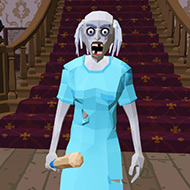
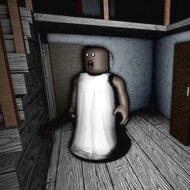
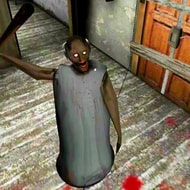
Granny’s house was already dangerous with one resident hunting you by sound. Granny: Chapter Two (Granny 2) does not simplify that problem — it adds Grandpa wandering the same darkened rooms, and introduces Slendrina, Granny and Grandpa’s granddaughter, into a setting that was already unforgiving before either of them showed up.
Two Residents Instead of One
The baseline threat in Granny: Chapter Two (Granny 2) works the same way it did before: Granny hears everything, and careless noise is usually what gets a player caught rather than being spotted outright. What changes in this entry is that Grandpa now shares patrol duties, wandering the dark house independently of Granny’s own movements. That doubling of active threats means a room that’s briefly safe from one resident isn’t necessarily safe from the other, and players have to track two separate presences instead of one. Even players who cleared the original house comfortably tend to describe this entry as a genuine step up in required awareness, simply because there’s no longer a single mental model of “where the threat is” that stays reliable for more than a few minutes at a time.
The main door remains covered with a series of different locks, and progress toward opening it still comes down to searching the house methodically for the specific items each lock requires. With two residents patrolling instead of one, that search takes on noticeably more risk than it did in the original house.
Slendrina’s Place in the Family
Slendrina is introduced in Granny: Chapter Two as Granny and Grandpa’s granddaughter, and her presence adds a layer to the house’s mythology beyond straightforward stalking. She appears specifically as a ghost in the backyard under a particular condition: if her Child is knocked out using the shotgun, the stun gun, or a hand grenade, Slendrina will hover directly above the Child’s body, scream, and remain fixed on the player for roughly forty seconds before the encounter ends. Unlike Granny or Grandpa, she doesn’t directly harm the player during this sequence — the scene functions more as an unsettling consequence of a specific action than as a direct threat to survive.
That distinction matters for how players approach the backyard specifically: engaging the Child with lethal tools carries a cost beyond the immediate encounter, since it’s what triggers Slendrina’s appearance in the first place, and the forty-second window she spends fixed on the player is enough time for Granny or Grandpa to close in from elsewhere in the house.
Assuming Only One Resident Is Listening
Players new to Granny: Chapter Two often assume the house behaves the same as the original game, moving and searching as if only one resident is tracking sound. Because Grandpa patrols independently of Granny, that assumption tends to lead to being caught by whichever resident the player wasn’t actively accounting for at the time.
Should You Ever Confront the Child in the Backyard?
It depends on what you’re prepared for — knocking out the Child with the shotgun, stun gun, or a hand grenade is what triggers Slendrina’s forty-second appearance, so that action should be a deliberate choice rather than an accident born of panic.
- Does Grandpa behave differently from Granny? Yes — Grandpa wanders the dark house independently, meaning players have to track two separate threats rather than one.
- Can Slendrina kill the player directly? Based on her documented appearance, she hovers over the Child’s body and screams for about forty seconds without directly harming the player during that sequence.
- Does the main door still use multiple locks? Yes, the main door remains covered in different locks requiring items found throughout the house, consistent with the escape structure the series is built around.
How This Entry Changed the Series’ Reputation
Granny: Chapter Two tends to come up in player discussion specifically because of how it expands the original formula without replacing it — the sound-based detection and item-hunting loop stay intact, but the addition of a second patrolling resident and a named family member with her own triggered sequence gives the house more to track and more lore to react to. Players comparing it to the original often describe the tension as compounding rather than simply repeating, since two unpredictable patrol patterns are harder to plan around than one.
The Slendrina sequence in particular gets singled out in discussion less for its danger and more for how it reframes what the player has just done — knocking out the Child stops being a purely tactical decision once her appearance makes the consequence visible and personal.
That reframing is part of a broader pattern across Granny: Chapter Two, where actions that read as simple obstacles at first — a locked door, a wandering resident, a strange object in the backyard — often turn out to be connected to something the game is quietly building toward. Players who go in expecting a straightforward repeat of the original house tend to be the ones most caught off guard by how much the family dynamic between Granny, Grandpa, and Slendrina actually shapes what happens during a run.
Escaping With Two Residents Awake
What separates Granny: Chapter Two from a simple reskin of the original house is how directly Grandpa’s independent patrol changes the math on every search. A hallway that was safe to linger in during the first game can no longer be assumed safe here, and that shift is exactly what keeps veteran players of the original on edge rather than coasting on familiarity. Between managing two residents and understanding what the backyard sequence actually costs, Granny: Chapter Two asks for a more careful read of the house than its predecessor did, and rewards players who treat every room as contested rather than empty. Whatever route a player eventually finds out, it’s rarely the same run twice, since Grandpa’s independent patrol means the exact sequence of near-misses changes from one attempt to the next.